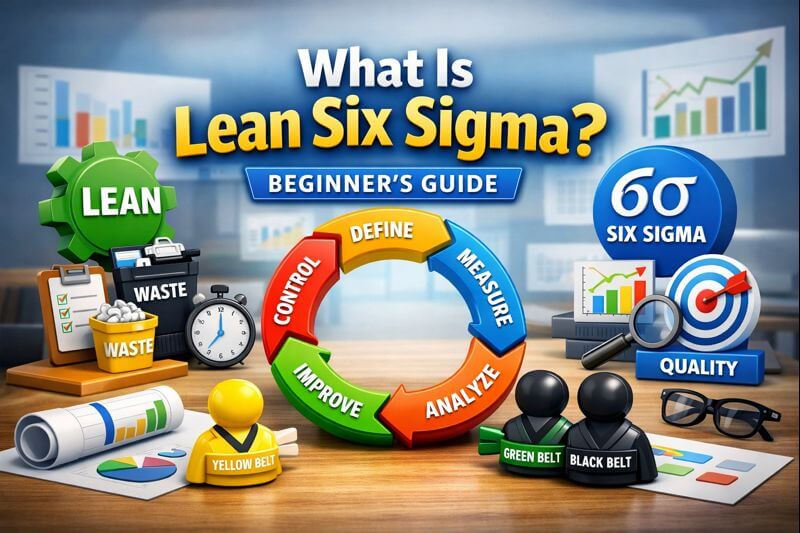
What Is Lean Six Sigma?
Lean Six Sigma is a structured, data-driven methodology used to improve processes by eliminating waste, reducing variation, and increasing efficiency. It helps organizations deliver consistent results, improve quality, and create more value for customers.
Unlike short-term fixes, Lean Six Sigma focuses on long-term, measurable improvement by understanding how work actually flows through a process and why problems occur.
Lean Six Sigma combines two well-established process improvement approaches:
Lean – focuses on speed and efficiency by removing non-value-adding activities
Six Sigma – focuses on accuracy and consistency by reducing defects and variation
When combined, Lean Six Sigma improves both how fast and how well a process performs.
What is Lean?
Lean is a management philosophy that aims to maximize value while minimizing waste.
In Lean thinking, “value” is defined from the customer’s perspective. Any activity that does not directly contribute to that value is considered waste and should be reduced or removed.
Common types of waste Lean addresses
- Waiting time between steps
- Unnecessary movement or handoffs
- Overproduction or doing more than required
- Rework caused by errors
- Excess inventory or information
- Unclear or overly complex processes
Example:
If a request must pass through multiple approvals that add no real value, Lean would challenge whether all those steps are truly needed.
What Is Six Sigma?
Six Sigma is a disciplined approach focused on reducing defects and process variation.
A defect is any outcome that does not meet defined requirements or expectations. Variation refers to inconsistency in how a process performs over time.
Six Sigma uses data, measurement, and analysis to:
Understand why defects occur
Identify root causes
Improve process reliability
The goal is to make processes predictable and stable, not dependent on individual effort or luck.
How Lean and Six Sigma complement each other
Lean improves flow but does not always address quality issues.
Six Sigma improves quality but may not address speed.
Lean Six Sigma integrates both to ensure that:
Processes are efficient and reliable
Improvements are measurable
Changes are sustainable
This balance is what makes Lean Six Sigma effective across different industries and functions.
Core principles of Lean Six Sigma
Lean Six Sigma is guided by a few fundamental principles:
Focus on the customer
Improvements should be driven by what the customer values, not internal assumptions.Understand the process
Decisions are based on how work actually happens, not how it is assumed to happen.Use data to drive decisions
Problems are identified and solved using facts, not opinions.Remove root causes, not symptoms
Temporary fixes are avoided in favor of permanent solutions.Create a culture of continuous improvement
Improvement is ongoing, not a one-time project.
What is the DMAIC methodology?
Lean Six Sigma projects typically follow the DMAIC framework, a structured problem-solving cycle.
- Define
Clearly state the problem, goals, scope, and customer requirements.
Example:
Customers are experiencing delays in service delivery
- Measure
Collect data to understand current performance and establish a baseline.
Example:
Average processing time, error rates, volume levels.
- Analyze
Identify the root causes of the problem using data analysis.
Example:
Bottlenecks, unclear responsibilities, system limitations.
- Improve
Develop and implement solutions that address root causes.
Example:
Simplifying steps, standardizing procedures, automation.
- Control
Ensure improvements are maintained over time.
Example:
Monitoring metrics, standard work instructions, ongoing reviews.
Where Lean Six Sigma is used
Lean Six Sigma is widely applied across industries and functions, including:
Operations and supply chain management
Healthcare and service delivery
Finance and accounting
Information technology
Customer support and administration
Any environment with repeatable processes can benefit from Lean Six Sigma.
Benefits of Lean Six Sigma
Organizations adopt Lean Six Sigma to achieve measurable results such as:
Reduced cycle times
Lower error rates
Improved customer satisfaction
Better use of resources
Increased process transparency
Beyond performance, it also helps teams understand their work better and make informed decisions.
Lean Six Sigma belt levels explained
Lean Six Sigma uses belt levels to indicate training depth and responsibility.
Yellow Belt
- Basic understanding of Lean Six Sigma concepts
- Participates in improvement initiatives
- Supports project teams
Green Belt
- Leads improvement projects part-time
- Applies analytical tools and methods
- Works under the guidance of Black Belts
Black Belt
- Leads complex, high-impact projects
- Coaches Green and Yellow Belts
- Drives strategic improvement efforts
The belt system provides structure but does not define hierarchy.
Lean Six Sigma provides a clear, structured way to improve performance, not through guesswork, but through understanding processes and using data.
For beginners, the most important takeaway is this:
Lean Six Sigma is about making work simpler, more consistent, and more effective step by step.
When applied correctly, it helps organizations move from reactive problem-solving to proactive improvement.