DMAIC Explained: The Complete Step-by-Step Guide to Process Improvement
Most businesses don’t struggle because of bad ideas.
They struggle because of broken processes.
Orders get delayed. Customers complain. Costs slowly rise. Teams keep fixing the same issues every month.
DMAIC is designed to stop that cycle.
DMAIC is a structured, data-driven methodology used to improve existing processes by identifying root causes, implementing effective solutions, and ensuring the improvements last. It stands for Define, Measure, Analyze, Improve, and Control.
This guide explains each phase clearly, with practical examples you can actually apply.
DMAIC is the core problem-solving framework used in Six Sigma methodology. Its purpose is simple: fix underperforming processes permanently.
Unlike general improvement approaches, DMAIC is structured. It doesn’t rely on guesswork or opinions. Every decision is based on measurable data.
It is especially powerful when:
A process already exists but isn’t performing well
The same problems keep reappearing
Costs are increasing without clear explanation
Quality inconsistencies are hurting customer satisfaction
DMAIC creates discipline inside organizations. It forces teams to think logically instead of react emotionally.
The 5 Steps of DMAIC Explained in Detail
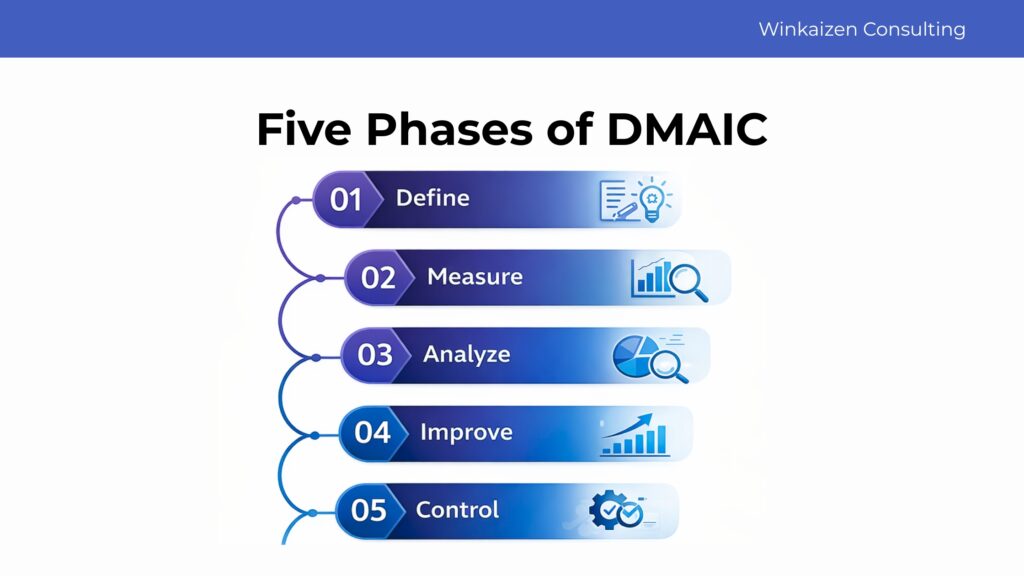
1. Define - Clarify the Real Problem
The Define phase sets the foundation for everything that follows.
Many companies rush this stage. They assume they already know the issue. That’s usually a mistake.
In this phase, you clearly identify:
What the problem is
Who is affected
The measurable impact
The scope of the project
The goal you want to achieve
For example, a logistics company might initially say, “Delivery times are inconsistent.” That’s too vague.
A proper DMAIC definition would be:
“Delivery delays exceed 48 hours in 27% of urban shipments, resulting in a 15% increase in customer complaints over the last quarter.”
Now the problem is measurable and specific.
Without this clarity, the rest of the process becomes unstable.
2. Measure - Understand the Current Performance
Once the problem is clearly defined, the next step is gathering reliable data.
This phase establishes a baseline.
You collect information about how the process currently performs. Depending on the business, this might include:
Cycle times
Defect rates
Customer response times
Production output
Operational costs
Error frequency
Let’s take a manufacturing example.
A company believes its defect rate is “high.” After measurement, they discover:
Defects occur in 6.4% of total units
70% of defects come from one specific production line
Most defects happen during the night shift
That data shifts the conversation from blame to diagnosis.
Measurement eliminates assumptions.
3) Analyze - Identify the Root Cause
This is the investigative phase.
Here, the goal is to determine why the problem exists — not just where it appears.
Common analysis tools include:
Root Cause Analysis
The 5 Whys technique
Fishbone (Ishikawa) diagrams
Pareto analysis
Process mapping
Continuing with the manufacturing example:
After analyzing the night shift defects, management discovers that new staff were not properly trained on updated machine calibration settings.
The issue wasn’t the equipment.
It was training gaps.
That insight prevents unnecessary equipment replacement costs.
The Analyze phase prevents expensive wrong decisions.
4. Improve - Implement Targeted Solutions
Once the root cause is confirmed, solutions are developed and tested.
This phase focuses on:
Designing process improvements
Running controlled tests
Implementing corrective actions
Measuring improvement results
In our example, the company:
Introduced standardized training modules
Created calibration checklists
Implemented supervisor sign-offs
Within two months, defect rates dropped from 6.4% to 2.1%.
The improvement worked because it addressed the actual cause.
DMAIC does not encourage random fixes. It requires evidence-based solutions.
5. Control - Sustain the Improvement
This is the most overlooked phase – and the most important for long-term success.
Many improvements fail because there is no monitoring system in place.
In the Control phase, you:
Create documentation and SOPs
Establish ongoing performance monitoring
Define ownership and accountability
Set alerts or dashboards to track performance
Conduct periodic audits
In the manufacturing case:
Monthly quality audits were scheduled
Automated reporting dashboards were implemented
Shift supervisors became accountable for defect tracking
This ensured the problem did not return.
Improvement without control is temporary.
When Should You Use DMAIC?
DMAIC is ideal when:
A process is already in place
Performance is measurable
The problem is recurring
Quick fixes have failed
Data is available or can be collected
It is not ideal for innovation projects or early-stage product development where no stable process exists yet.
Business Benefits of DMAIC
When implemented properly, DMAIC delivers:
Reduced defects and rework
Lower operational costs
Increased efficiency
Higher customer satisfaction
Better decision-making through data
Stronger process accountability
More importantly, it builds a culture of structured problem-solving.
Organizations stop reacting and start diagnosing.
DMAIC vs Other Process Improvement Methods
While there are several improvement frameworks, DMAIC stands out because of its structure and depth.
PDCA (Plan-Do-Check-Act) is flexible but less rigorous in root cause analysis.
Kaizen focuses on continuous incremental improvements.
Lean emphasizes waste reduction.
DMAIC is best suited for high-impact problems requiring measurable, long-term solutions.
FAQs – Difference Between Lean and Six Sigma
DMAIC stands for Define, Measure, Analyze, Improve, and Control. It is a structured methodology used in Six Sigma to improve existing processes.
No. DMAIC is widely used in healthcare, finance, IT, customer service, logistics, and service industries.
Small projects may take 4–8 weeks. Larger operational transformations may require several months.
Certification is helpful but not required. Many businesses use DMAIC principles without formal certification.
About Winkaizen’s Lean Six Sigma Training & Consulting
Winkaizen is a process improvement and business excellence firm that helps professionals and organizations apply Lean Six Sigma principles in real-world environments. Our programs are designed for working professionals, managers, and teams who want practical skills, not just theory.
At Winkaizen, we focus on application-driven learning. Every Lean Six Sigma concept is explained with business-relevant examples, industry use cases, and implementation guidance so learners can immediately apply what they learn to improve performance, reduce waste, and deliver measurable results.
Our Lean Six Sigma training and consulting solutions support organizations across manufacturing, IT, healthcare, BFSI, shared services, and operations-driven industries.
Winkaizen Offers the Following Lean Six Sigma Programs online: