Why Process Improvement Fails
Process improvement sounds simple on paper. Map the process, fix the gaps, save time, reduce cost, move on.
Yet in real organisations, improvement initiatives quietly stall, get abandoned halfway, or deliver short-term gains that disappear within months.
This isn’t because teams are lazy or resistant by default. Process improvement fails for much deeper, more human reasons most of which are avoidable if you know where things go wrong.

One of the biggest reasons improvement efforts fail is mindset.
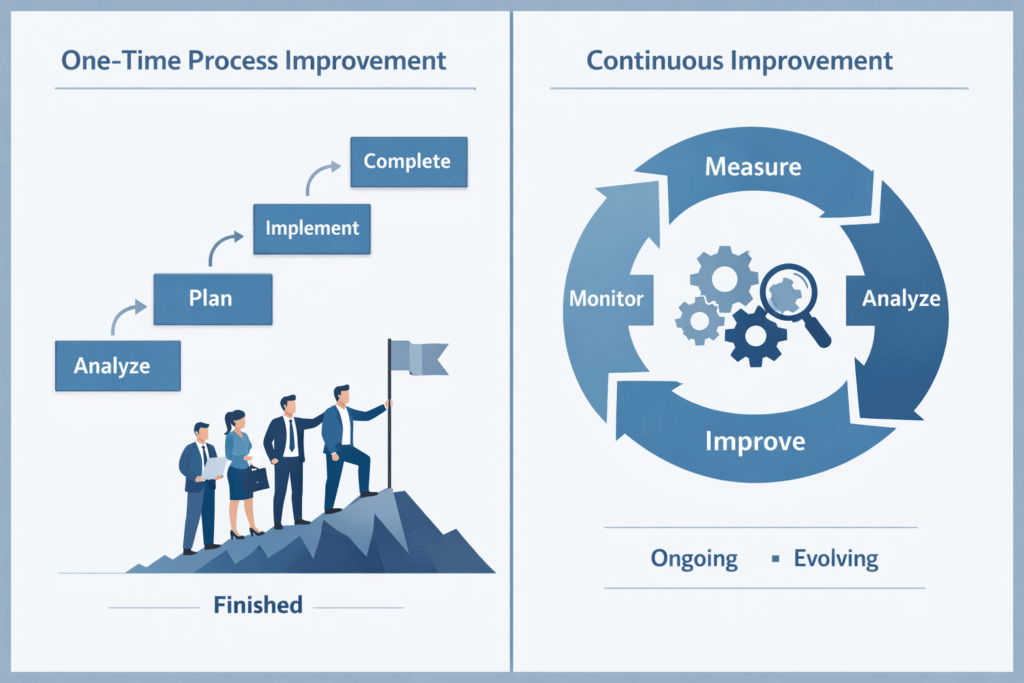
Many organisations treat process improvement as a project with a start and end date instead of a way of working. A team is formed, workshops are conducted, documents are created and then everyone returns to business as usual.
When improvement is treated as temporary, old habits return, performance tracking stops, and leadership attention shifts elsewhere. Sustainable improvement only happens when it becomes part of everyday decision-making.
Leadership Support Exists in Words, Not Actions
Executives often claim to support process improvement, but behaviour tells a different story.
When leaders stop attending reviews, don’t ask for data before making decisions, or fail to remove barriers raised by teams, employees quickly understand that improvement is not a real priority.
What Real Leadership Support Looks Like
True support shows up when leaders actively use process data, protect time for improvement work, and hold teams accountable to new standards. Without visible leadership involvement, even well-designed initiatives lose momentum.
Teams Are Expected to Improve Without Time or Authority
Another common reason process improvement fails is unrealistic expectations placed on employees.
People are asked to improve processes while managing full workloads, without adjusting priorities or granting authority to make meaningful changes. This creates frustration rather than results.
Why Improvement Work Needs Ownership
For improvement to succeed, teams need dedicated time, clear ownership, and permission to challenge existing ways of working. Without these, improvement remains theoretical.
Organisations Fix Symptoms Instead of Root Causes
Many improvement initiatives fail because they focus on visible problems rather than underlying causes.
Automation is added to broken workflows, additional checks are introduced instead of fixing upstream issues, and training is used to solve design flaws. These quick fixes avoid uncomfortable conversations but fail to deliver lasting change.
The Cost of Avoiding Root Cause Analysis
When structural issues, conflicting KPIs, or leadership decisions remain unaddressed, the same problems resurface repeatedly often with greater complexity.
Tools Are Prioritised Over Thinking
Frameworks and tools are helpful, but they are often mistaken for solutions.
Process improvement fails when teams follow templates mechanically, copy best practices blindly, or focus more on documentation than real problem-solving.
Tools Should Support, Not Replace, Critical Thinking
Improvement succeeds when tools enable better decisions not when they become an end in themselves
Success Metrics Are Unclear or Missing
If no one knows how success is measured, improvement loses credibility.
Many initiatives fail because baselines are not established, metrics are too vague, or results are not tracked after implementation. Without clear measurement, wins go unnoticed and failures persist.
Culture Rewards Firefighting Instead of Prevention
In many organisations, employees who fix urgent problems are praised more than those who prevent them.
This creates a culture where short-term fixes dominate and long-term improvement feels optional. Over time, teams stop investing in prevention because it is not recognised or rewarded.
Change Is Announced but Not Managed
Even well-designed improvements fail when change management is ignored.
People resist change when they don’t understand the reason behind it or feel excluded from the process. Without communication, involvement, and feedback loops, adoption remains low.
Why Involvement Drives Adoption
When employees understand why change matters and are involved early, improvement becomes something they support not something imposed on them.
What Successful Organisations Do Differently
Organisations that consistently improve processes approach improvement differently.
They treat it as an ongoing discipline, expect leaders to model the right behaviours, invest in problem-solving skills, and review results regularly. Improvement becomes the way work gets done, not an extra task.
Frequently Asked Questions
They fail due to weak leadership follow-through, lack of clear metrics, insufficient employee involvement, and poor integration into daily operations.
No. Resistance usually reflects unclear communication, lack of involvement, or changes that increase workload without solving real problems.
Yes. Tools alone cannot fix misaligned incentives or weak leadership behaviour.
Some improvements deliver quick wins, but sustainable results require consistent review and refinement over time.
About Winkaizen’s Lean Six Sigma Training & Consulting
Winkaizen is a process improvement and business excellence firm that helps professionals and organizations apply Lean Six Sigma principles in real-world environments. Our programs are designed for working professionals, managers, and teams who want practical skills, not just theory.
At Winkaizen, we focus on application-driven learning. Every Lean Six Sigma concept is explained with business-relevant examples, industry use cases, and implementation guidance so learners can immediately apply what they learn to improve performance, reduce waste, and deliver measurable results.
Our Lean Six Sigma training and consulting solutions support organizations across manufacturing, IT, healthcare, BFSI, shared services, and operations-driven industries.
Winkaizen Offers the Following Lean Six Sigma Programs online: